Home → Fish & Wildlife → Citizen Science Projects → Maine Nest Quest
Maine Nest Quest
A mission to map Maine's nesting swifts and swallows.
Who are Maine's Swifts and Swallows
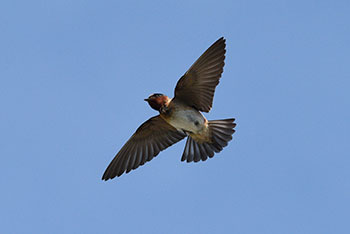
Cliff Swallow photo by Linda Merry
Aerial insectivores are animals that forage by capturing insects during flight, a method known as feeding "on the wing". Birds that use this method – avian aerial insectivores – include nightjars, flycatchers, swifts, and swallows, such as these Maine Nest Quest species:
- Bank swallow
- Cliff swallow
- Barn swallow
- Tree swallow
- Northern rough-winged swallow
- Chimney swift
Avian aerial insectivores are experiencing some of the steepest and most widespread population declines of any bird group in North America, especially in the Northeast. Nesting habitat loss and instability, reduced prey due to pesticides, climate-driven shifts in timing of food resources, and stressors during migration, all put pressure on aerial insectivore populations.
The decline of bank swallows and cliff swallows, both State Threatened species in Maine, is particularly staggering. The Maine Bird Atlas has revealed the disappearance of bank swallows and cliff swallows from nearly 50% of their historic ranges in Maine. For this reason, bank and cliff swallow nesting colonies are the primary focus of Maine Nest Quest.
About the Project
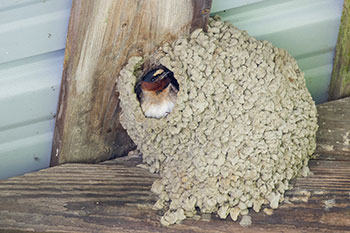
Cliff Swallow in a mud nest
Bank and cliff swallow colonies are becoming few and far between. Although we understand the general habitats these species use for foraging and the types of features they use for nesting, many colonies remain undocumented across Maine. Understanding where successful nesting occurs is critical to population assessments and effective conservation planning, including protection of important habitat.
Maine Nest Quest will help bridge this knowledge gap by using the power of community science to map nesting observations across Maine. All you have to do is report colonies when you see them!
As we learn where colonies exist, what habitats they are using, and how nesting strategies and success change over time, we will build a stronger foundation for future monitoring and a shift toward proactive and targeted conservation efforts. Every observation counts. If you are a birder, paddler, angler, landowner or just like a good outdoor scavenger hunt, this project is for you!
How to Participate
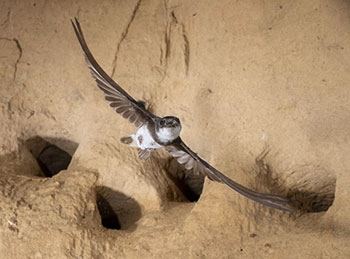
Bank swallow photo courtesy of Brock and Sherri Fenton
Spot a swallow colony? Let us know! It only takes a few minutes to fill out Maine Nest Quest online form. Photos not required but are helpful and encouraged when possible, without disturbing nesting birds.
To submit a report, you'll answer a few basic questions about the:
- Colony location and features
- Date of observation
- Species (if known) and activity observed
- Number and condition of nests
There is no minimum commitment to participate, and this project isn't just for expert birders. Anyone could be the next community scientist to add a dot to Maine's swift and swallow map. From casual observations to dedicated exploration, how you join the Nest Quest flock is up to you!
- Observation: Do a quick check around your home or business during nesting season.
- Exploration: Add Maine Nest Quest to your next paddling, fishing, or hiking adventure.
- Discovery: Challenge yourself with a targeted search for colonies in natural habitat.
If you already report bird observations through eBird, we encourage you to continue doing so but submit to Maine Nest Quest as well. Specific details collected through Maine Nest Quest, not consistently captured through eBird, build a clearer picture of where nesting occurs and allow for landowner follow-up for future monitoring and state-level conservation planning.
When to Submit Observations
May - August
The best chance to collect and submit data is while birds are actively nesting. In Maine, most nesting activity occurs from May through early August. Observations outside of the breeding season are still valuable, so if you notice evidence of a colony in fall or winter such as likely bank swallow burrows in a riverbank or unoccupied mud nests on a bridge or building, we encourage you to report. These observations will help prioritize sites for future monitoring.
Which Species to Report
Bank Swallows and Cliff Swallows are the top priority for Maine Nest Quest
Nesting observations of most Maine swifts and swallows can be submitted through Maine Nest Quest, but the current focus is to map colonies of two avian aerial insectivore species currently listed as Threatened in Maine - bank swallows and cliff swallows.
If you don't know which species you saw, that's okay! Include photos with your submission when possible, and our biologists will review your observation.
To report observations of nightjars and purple martins, please contact MDIFW Songbird Biologist, Mackenzie Roeder, at mackenzie.roeder@maine.gov
Where to Find Colonies
Swifts and swallows use a range of habitats across Maine, including rivers, wetlands, coastal areas, farmland, forests, and developed landscapes. Both bank swallows and cliff swallows can nest in either natural habitats or human-made structures. While human-altered sites can be an important resource, they may also introduce new risks such as reduced food quality, overheating, instability of nesting sites, and human-wildlife conflict.
Maine Nest Quest is interested in observations of nesting colonies in both natural and developed settings. Colonies in natural habitats can be especially difficult to locate and are particularly valuable to the project. Finding one can be a rewarding quest for adventurous community scientists.
Bank Swallows
Look for many small holes clustered in vertical sand or soil banks in gravel pits, road cuts, excavated areas, eroding riverbanks and shorelines.
Bank swallows historically nested in natural habitats by excavating burrows in vertical banks along rivers, lakeshores, and coastal bluffs. These features have been altered or lost in many parts of the Northeast due to erosion control, shoreline stabilization, and development. In response, Bank swallows now rely heavily on gravel pits, road cuts, and other excavation areas.
Cliff Swallows
Look for gourd-shaped mud nests attached to vertical surfaces of bridges, buildings, culverts, and natural cliff faces.
Cliff swallows have a long history of nesting on natural cliff faces with protective overhangs in western North America. Their eastward range expansion was associated with availability of human-made structures for nesting. Natural cliff faces suitable for nesting cliff swallows are rare in the Northeast, but active colonies in these areas may still exist, and Maine Nest Questers can help find them!
How to Find Colonies
The best clues for nesting colony locations often come from watching bird behavior. Mornings are often the most active time so early birders may have the most luck. Observations of birds repeatedly flying to and from the same area are a great start. Cliff swallows use mud to build their nests. If you see a group collecting mud, try to notice where they take it!
Bring binoculars. Ethical birding practices apply to community science too. Observe responsibly from a distance without approaching colonies too closely, flushing birds from nests, or handling birds. You don't need to see eggs or young to record signs of nesting. Birds occupying, entering, exiting, or building a nest or burrow is enough for a valuable report. Even reports of unoccupied nesting sites off-season are helpful.